The Prototyping Room
The Aisle of Alternatives
Making webpages nowadays
If the web’s architecture has evolved and new features, advanced programming languages have emerged, the original purpose of the web remains: sharing files!
The web is all about sharing files
Your internet browser can open all sorts of files:
- An image: .jpg, .png, .webp
- A moving image: .gif
- A sound: .mp3, .wav
- A video: .mp4, .mov
- A document: .pdf
- A simple text: .txt
- and of course a webpage file: .html
Ultimately, when you visit a web page, a server (a computer without screen that is always online) is sending you back files: an index.html, that displays as a interactive web page, but also videos, images, etc.
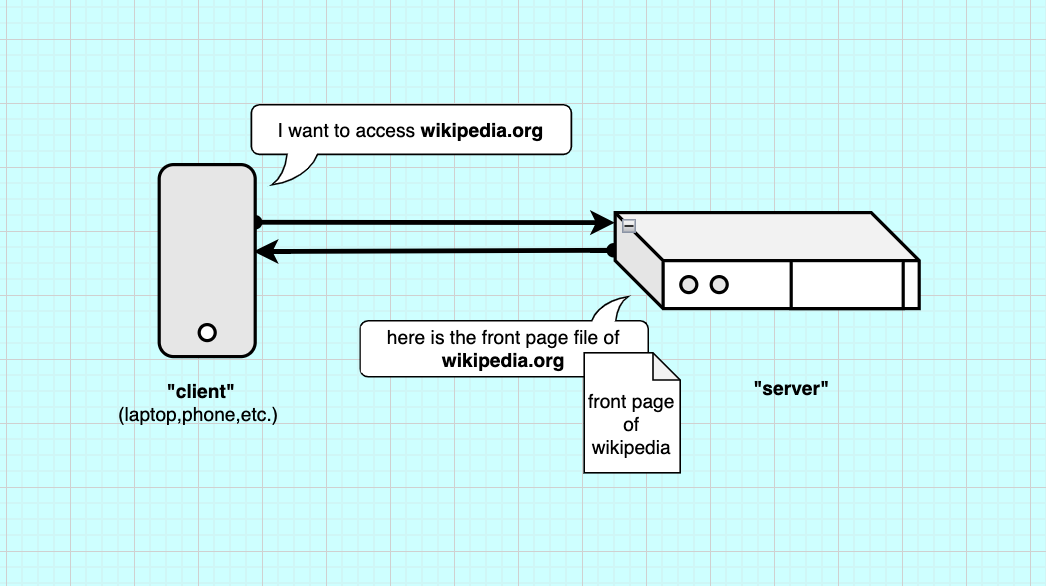
How a server works: serving informations or data back to clients or other servers. Illustration by Marie Verdeil. License CC-BY-SA-NC
A webpage is a room, what should it contain?
As we see it, a webpage is ultimately a room, on a remote computer, that contains content, in the form of text, images or video files, arranged with a certain layout. What would make sense to host there? Let’s think about it and create our own rooms online.
HTML, CSS, JS by Laurel Schwulst. A website is built with 3 main programming lagnuages: HTML takes care of the site’s architecture, CSS handles appearance and JS can perform interractive tasks, like complex animations or dynamic content.

To style our web page, we use CSS declarations, words to describe background color, width, borders, font size, etc. A collection of cool CSS words by artist Doriane Timmermans